
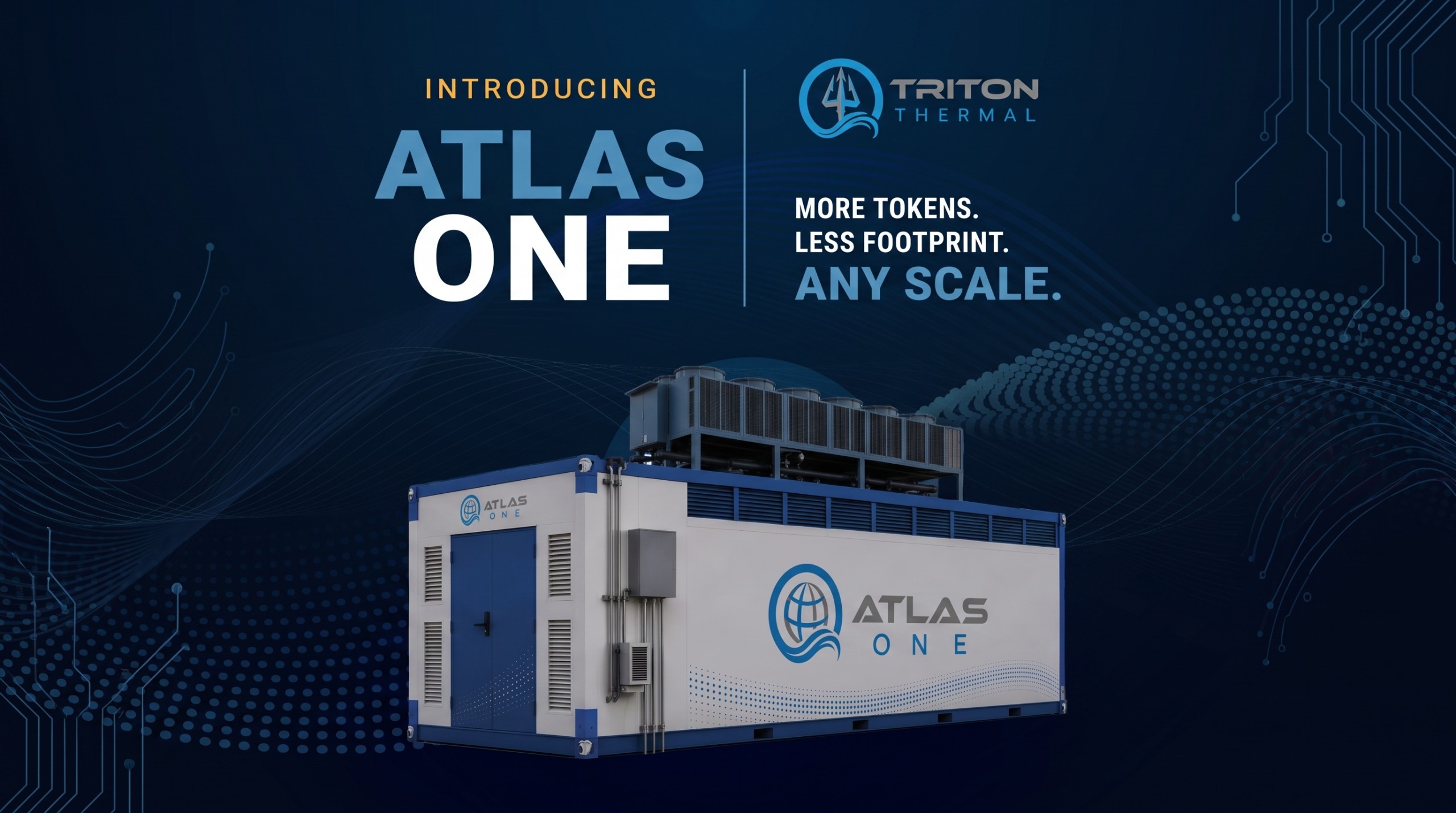
The AI race is increasingly measured in tokens, not square feet. Every organization racing to deploy more compute is running into the same three walls at once: not enough space, not enough power density, and not enough time to build the traditional way.
Atlas One is Triton Thermal’s answer—a modular, factory-integrated AI infrastructure platform designed to deliver more compute in less space, with greater efficiency, on a timeline measured in weeks instead of years. From a single module to a global fleet, it provides a repeatable path to scalable, high-density compute.
What Is Atlas One?
Atlas One isn’t a single product bolted onto an existing data hall. It’s a fully engineered platform. The enclosure, power, cooling, controls, and monitoring aren’t pieced together on-site—Triton designs, procures, integrates, and factory-tests them as one unified system first.
That distinction matters. Most AI infrastructure delays don’t come from the compute itself. They come from the dozens of separate systems around it: power distribution, thermal management, controls, monitoring. Teams normally specify and integrate all of that for the first time on-site, in the field, under schedule pressure. Every integration point becomes a place a project can slip.
An AI data center is only as reliable as the systems connecting its power, cooling, controls, monitoring, and physical infrastructure. Atlas One removes that field-integration risk by doing the work in a controlled factory environment first—the same mechanical contractor discipline Triton Thermal applies on every engagement, just packaged into a factory-built module instead of a field build. It isn’t a collection of components someone assembles on-site. It’s one engineered platform, with one accountable team behind it.
Built for Rapid, Repeatable Deployment
Traditional data center construction can take 18 to 36 months, start to finish. Atlas One cuts that down to weeks. It replaces custom, on-site construction with a factory-built, site-ready module. The enclosure, power, cooling, controls, and monitoring arrive already integrated and pre-tested. Crews handle utility connections and commissioning—that’s most of what’s left to do in the field.
Mission-critical infrastructure shouldn’t depend on hundreds of variables coming together for the first time on-site. Testing each module in a controlled factory environment first improves consistency, cuts on-site complexity, and gets organizations from planning to production faster than a traditional build allows.
That speed doesn’t cost consistency. Traditional data center expansion usually means starting over: a new custom design, new construction variables, a new learning curve at every site. Atlas One skips that. Every module follows the same platform, the same quality requirements, the same operating model. That gives organizations a predictable way to expand AI capacity across sites and geographies—one facility in Houston, where Triton Thermal’s engineering team is based, or a dozen spread across the country.
Engineered for High-Density Compute
Atlas One is built to support extreme-density compute—the kind of rack densities that traditional air cooling was never designed to sustain. Under the hood, it’s engineered around single-phase immersion cooling, which is what allows the platform to support that density without the thermal ceiling that limits air-cooled deployments.
The platform is engineered for current and next-generation AI accelerators and CPU workloads, including NVIDIA’s Blackwell architecture and Rubin, NVIDIA Hopper and RTX Series, AMD MI350X and MI300X, and mixed or transitional legacy deployments—so organizations can build for today’s workloads without boxing themselves out of what comes next as hardware generations turn over faster than most infrastructure cycles can typically absorb.
Scale by the Megawatt, Not by the Project
Scaling AI capacity has historically meant starting over: a new design, a new set of contractors, a new set of unknowns, every time an organization needs more capacity. Atlas One is built around a different model. Operators deploy the first module, establish a proven design, and add repeatable infrastructure blocks as capacity requirements grow.
One module or one hundred. One site, or locations around the world. The platform, quality standards, and operational playbook stay consistent at every scale—which turns capacity planning from a series of one-off construction projects into a repeatable operational decision.
One Accountable Program
Complex AI infrastructure projects typically involve multiple suppliers, contractors, and disconnected scopes of work—which is exactly where schedule risk, cost overruns, and finger-pointing tend to live when something goes wrong. Atlas One brings engineering, procurement, integration, logistics, commissioning, and support together under one accountable program, from the first module to a global fleet. Organizations get a single coordinated path from capacity planning to operation, rather than managing a patchwork of vendors and hoping the handoffs go smoothly.